


Hey folks, welcome to another issue. It's been a few weeks since I started, and it's been a fulfilling experience.
Before I get into this week's topic, I want to take a moment to express my gratitude for your interest in my work. I haven't promoted the newsletter anywhere, so there aren't many of you, but to the ones that joined me from the start - extra brownie points!
If you enjoy the stuff I write about, it'd be great to share the newsletter with one friend or colleague you believe might find it helpful. Thank you!
Micro-SaaS vs. traditional SaaS
There's so much written on SaaS pricing models. While most of it applies (somewhat, at least) to micro-SaaS companies, I wanted to share some specifics you need to consider when pricing your micro-SaaS so you don't go with a model that won't work well for you.
Micro-SaaS is all the craze now, and many analysts believe it's the future of business. Others claim subscription models are going out of style, and the era of one-time purchases will soon come, especially with how cheap server resources are becoming. We used to buy software for a one-time fee, but now we pay for dozens of apps per month, and soon, we may go full circle and end up paying upfront instead of using a subscription once again. Marketplaces like AppSumo have successfully promoted lifetime deals over the past years, so who knows?
Micro-SaaS distinctive characteristics
There are a few specifics around what businesses fall under the micro-SaaS type. It's important to note these, as they are the most common reason traditional SaaS business models don't always work well for micro-SaaS companies.
Solo founder or a tiny team
Offer a solution to a single specific problem
Very niche audience and use case
No need for significant funding to get going; often bootstrapped
Usually aimed to be a lifestyle business
Those are the main particulars of micro-SaaS businesses. And exactly, those are the main reason such ventures are gaining popularity fast. However, this poses the need for adjusted pricing models catering to the micro-SaaS ecosystem.
Picking a pricing model
Over the past few months, I've been researching many micro-SaaS founder stories, and one thing stood out about how they were pricing their offering. I was particularly interested in learning more about how they came up with their pricing strategies and what models they picked.
Let's look at the most common traiditional SaaS pricing models and discuss why they usually don't work well for a micro-SaaS.
Per-user pricing
This is one of the most common ones. There's a price per user to access all features of the product. The larger the team, the higher the price. It seems pretty simple on the surface, but it rarely is. These plans often also have a few pre-set team sizes, and the available features might also change as you move to a more expensive plan with a larger team (e.g., advanced user management features, more collaboration options, etc.).
This pricing model often incorporates two variables - the available features and the team size- making it much more complicated than it initially seems.
Supporting such varied plans can become quite the administrative burden for a single founder or even a small team with no dedicated billing and customer support functions.
Additionally, we need to think about the customers of a micro-SaaS app. Having a big enterprise that needs multiple seats as a customer would probably be a rare case. So, there's no real need to have the per-user pricing. If such customers come, you can always sign them separately, not through your regular pricing page.
Based on different use cases
These are also quite common. A SaaS may have one plan for freelancers, another for website owners, and a separate one for agencies building sites for clients on a much larger scale.
This model can also quickly become hard to manage in the case of a micro-SaaS company. Many founders also pick the wrong split of their plans. For example, offering a tier for 1 and 30 websites when 80% of their audience wants a plan for 3 websites. Additionally, if we keep adding more options, it can quickly get to a point where potential users are anxious to pick the right plan and end up regretting their choice and canceling.
Usage-based pricing
This became even more popular in the current age of generative AI. For example, OpenAI's pricing for access to their APIs is based on 1000 token increments.
While using a so-called pay-as-you-go model may seem like an excellent idea, it can pose significant challenges for a solo founder. Billing can quickly become a nightmare, especially if you don't have sophisticated and transparent usage tracking. Some customers are bound to dispute the usage; others would feel a larger usage volume should grant them discounts, etc.
Unless you have a particular offering that only works with usage-based pricing, I'd avoid this model in the early stages of a company.
Flat pricing
This one is straightforward. Set a flat price and charge everyone the same amount, regardless of seats, usage, etc.
I think it's the most manageable pricing model to start with for a micro-SaaS. It keeps your billing simple, allowing you to test and iterate quickly.

Those are the most common pricing models I see people use in SaaS and try to use in micro-SaaS. As you can probably tell, they are pretty intertwined. For example, a pricing plan based on a use case is still flat within the particular use case.
Free plan vs. Free trial vs. Paid only
When structuring your pricing models, you should consider whether you'll provide free trials or have a feature-limited free version of your product.
I am not a big fan of providing free plans, as it can quickly take too much of your time, which can be pretty harsh for a micro-SaaS where you do most, if not all, of the work. However, if your product can generate virality, then by all means, you should have a free plan. For example, GoPro's mobile app allows you to create videos for free but then adds a short promo at the end of the video to say it was shot on their camera. But I'd always skip the free version for anything that can't generate and benefit from virality.
Give your potential customers a free trial period instead. You can usually go with 7 to 30 days, depending on how much time it takes to get up to speed with using your product. Or, if you are a bit more established, switch to a money-back guarantee instead of a free trial.
I think the paid-only version doesn't work well for micro-SaaS companies unless you provide a very high ticket service/product and already have some reputation. Then, by all means, charge as much as you can in advance.
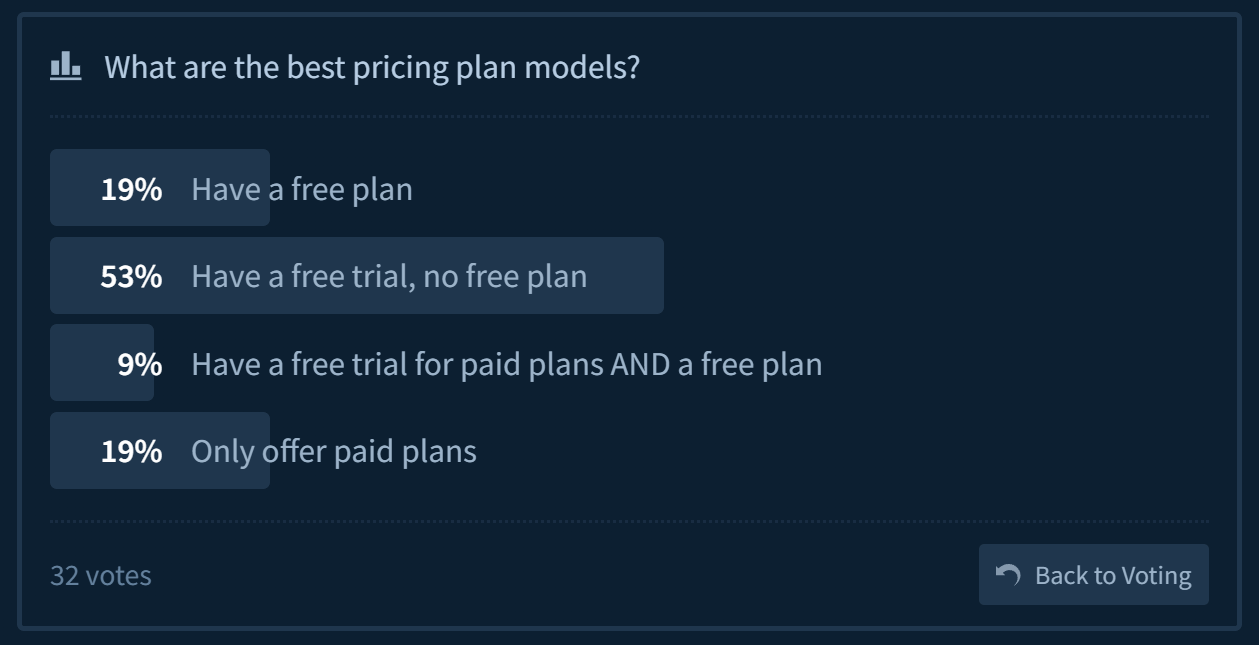
There's a post in Indie Hackers where 30+ people voted on their pricing model preferences, and here's what they said:
So what about micro-SaaS?
We can go much deeper into the different SaaS pricing models, how to combine them, and many nuances. But I'd rather spend some time on how to think about setting the pricing strategy for your micro-SaaS.
I've been reading up on this topic and wanted to share some of the most common suggestions I found. Let's go.
First, if you only remember one thing, let it be the following sentence.
Keep it as simple as possible!
Think about the pricing options you want to present. Having as few pricing tiers as possible is a great strategy, especially in the beginning. Having Monthly and Yearly plans is more than enough in 95% of the cases. It allows you to provide some flexibility (e.g., including a discount in the yearly plan) while not overcomplicating the process for your users and billing.
Use the right metrics to scale pricing.
In some cases, it makes sense to have a usage-based pricing model. I'm not talking about tokenized usage or anything too granular. But if your offering incurs more costs when some factor scales up, figure out this factor and make it affect the pricing plans. This model is not very simple, as it requires more work from the already-thin-spread team of your micro-SaaS, but if you pick the right scaling metric, it can work really well.
However, you need to dial down your scaling metric and communicate how this affects your costs in a crystal clear way to your prospects and customers. For example, for a small, unknown micro-SaaS social media management tool, charging by the number of linked social media accounts makes little sense, as this won't impact your costs. But making your pricing contingent on it will add unnecessary complexity to your business operations. However, offering any hardware device (e.g., POS system for taco trucks, GPS trackers for fleet management) would increase your cost significantly. In such cases, you can have a starting price for the backend system and several devices that makes sense for the industry and then charge extra for every additional taco truck or car added.
Pick your price carefully.
This is probably where you should spend most of your pricing strategy time, not on trying to develop an elaborate professional-looking pricing model that will only come back to cause you issues.
I see many micro-SaaS founders shy away from setting a fair price. No one will take your product seriously if you price it at $5 monthly. You might get many more conversions initially, but those won't be quality customers, and they will churn quickly.
Spend some time and try to figure out the fair price for your product. Look at competitors, similar products serving other industries, similar offerings, etc. Then drop it 3 to 4 times, and start with that.
For example, say your analysis shows that $100 a month is a fair price for your product's value. Start with $25 to $35 monthly and see how this goes. Use those early customers to get feedback and refine your product and offering. Then, start charging more. Get to the point where customers complain but are still paying. You can go above the initial price you envisioned if people are still willing to pay.
Free plans and free trials
We already touched on this, but I want to clarify my position a bit more.
Only offer a free plan if you have at least 2 strong differentiating features. Then, you can put one behind a paywall. Anything else, like the number of uses, tokens, etc., won't work as well. I've personally created numerous accounts for the same service to circumvent the paywall by spreading my usage across a few accounts.
As for the free trials, lately, I've been reading and seeing more and more people not offer free trials but provide a generous money-back guarantee instead. And the more I think about it, the more it makes sense in most cases.
Trials are great, but only if your product is fantastic because then people on the fence can try it, and the product itself will close the deal for you. But if your product sucks (and it most probably will at first), people won't use it and cancel their accounts before being charged. With a money-back guarantee, on the other hand, people have to pay from the start, meaning they will be much more interested in using your product and getting the maximum value out of it.
Another thing to ponder regarding having a freemium model is that you can go out of business because of great success. If servicing free users costs you money and time (especially if you have a small team that replies to all support questions), you can go bankrupt supporting free users. So, growing your free user base is not always good.
So, be careful and think through your cost structure very carefully before offering a free plan.
Remember that charging users makes them customers, which lets them know you'll support them as long as they pay, which is good for them and gives them additional peace of mind.
Lifetime deals
These have been gaining more and more popularity in the past few years, thanks to platforms like AppSumo and thanks to server costs going down. Running lifetime deals can be a great way to jumpstart your micro-SaaS, but only if it makes sense financially.
Your customer servicing costs going forward have to be close to zero for this to make sense in the long term (ideally, zero).
Other than that, it's also a significant marketing boost, as people get the perception of more value than they are paying for.
Most people would pay $60 for lifetime access to something they would've churned out of in 3 months if it was priced at $10. I don't know what it is (and haven't researched it), but some weird psychology is happening here.

These were the main points I wanted to share about pricing your micro-SaaS.
Remember, there's no one-size-fits-all approach here, and you will have to do the work to research and test your pricing. But, generally, you should aim for a simpler pricing model to make your life easier.
And most importantly, make sure your pricing supports the delivery costs to serve your clients. Otherwise, you don't have a business (or won't have a business pretty soon).
This is it for this issue. Reply to this email or leave a comment below to let me know your thoughts about pricing a micro-SaaS product.
Thank you all who made it to the end of this issue. As always, extra brownie points go to those who share the newsletter with a friend (or a few if you want more points and feel competitive!), By sharing, you help me grow the newsletter and spread value to more people. It also feels pretty rewarding, not going to lie!
Till next week,
Dobri