


Hey there!
Welcome to this week's edition of the Minty Analyst newsletter. Today, I want to share some thoughts about the biggest enemy of any creative person: the blank page.
I don't know a single content creator who doesn't have a story (or many) about struggling with writer's block (or let's call it creator's block, as it doesn't only affect writers).
What is writer's block?
It's a horrible feeling, especially in fast-paced circumstances with a content calendar filled with deadlines.
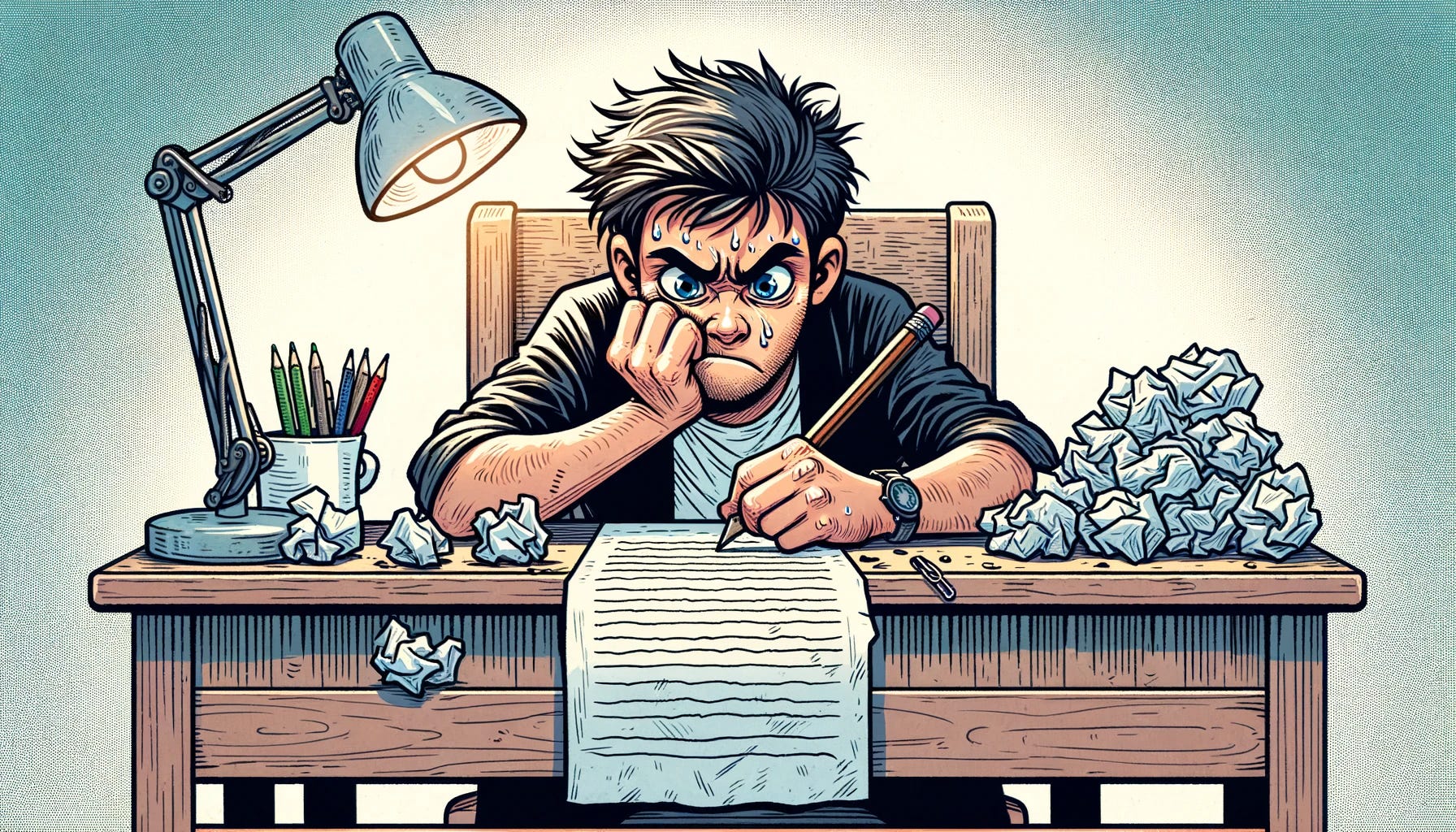
You sit down to write, design, paint, or do any creative work (and a lot of non-creative work, for that matter), and there's nothing. It feels as if you have exhausted all the themes and topics in the world, as if your mind is empty. There is an empty white void instead of the regular repository of ideas.
It's the complete (and horrifying) lack of ideas. It's not just great and good ideas that are not coming. There's literally nothing.
For me, creator's block inflicts a special kind of emotional damage. It makes me feel like a total failure, as if not being able to come up with an idea today erases all the content I have produced previously. Staring at a blank page and feeling the white void growing inside me sends shivers down to my very core.
I feel like a complete fraud. I start doubting what I'm doing and why I'm doing it. I begin to question the authenticity of my previous ideas and content.
If it continues for too long, and I cannot break writer's block with some taped-up idea, I start feeling really miserable.
It might sound overstated, but I write and make videos as a creative outlet, sharing knowledge or engaging (I hope) experiences. It's not my full-time job, not even a second job. It's a hobby that I struggle to carve out time for. And when this 1-hour time slot that I barely managed to dedicate comes, and I spend the first 30 minutes staring at a blank page, it's a genuinely dreadful feeling.
I feel small. Insignificant. Worthless.
How to deal with it?
If I had a penny for every article I've read about dealing with writer's block, I'd probably have around $1.50. There's so much information online and so many remedies, some of which even claim to be scientifically backed. I don't know if all of them work or if none do. However, I've tried many things and want to share what works for me, hoping you may find something that works for you.
Brainstorm with ChatGPT
This is new (there was no ChatGPT 18 months ago), but it is one of my absolute favorites. Get your free ChatGPT account and just prompt it.
You can prompt it for topic ideas. For example, you may say you write listicles in X niche and ask it for topic ideas. Or you may say that you make videos about failed startups and ask it for a list of such. The paid GPT-4 model that can do internet research will probably better answer the same query, but you never know. The free ChatGPT-3.5 is sometimes surprisingly on point.
Alternatively, you may try asking for ideas on how to spark creativity. This is also a great option. Ask for mental exercises to help you solve the underlying problem (not having ideas) versus giving you a ready list of ideas. It might work better for you, depending on what you prefer.
I usually grab the topics and titles of my last 10 pieces of content. Sometimes, I might add a short description for each one as well. Then, I paste this data into ChatGPT and ask it to provide complementary topics. Funny enough, I rarely end up picking one of the suggested topics. Almost every single time, I come up with an idea that fits my content perfectly while trying to figure out if ChatGPT's ideas would work.
Change writing tools
This is one of my favorite ones. It's also the simplest one. I have a great example from when I first started writing blog posts a few years back. We were visiting my grandparents, and I was looking through the junk they'd accumulated over the decades when I found a working typewriter. It was used as a centerpiece on one of their guest tables, but it looked like someone cleaned it up and made it operational again. Turns out, that's what they did. It was working, had an ink tape (or whatever the cloth roll drenched in ink is called), and even had a sheet of paper loaded.
I sat down and started typing. It was such a fun experience. I remembered playing with a typewriter as a kid but never used one for writing. So I sat there for more than an hour, typing away. It was nothing revolutionary, but I wrote about 90% of my next article. An article I had thought about for a few days but couldn't figure out what the outline should be. On the typewriter, I didn't even need an outline. It all just flowed out of me.
I was so energized by using a new writing medium that it helped me unclog my brain. I purchased the reMarkable 2 Type Folio (a fancy keyboard cover for the reMarkable 2 paper tablet) a few months back. It was life-changing. It was so different from writing on a computer that I even started this newsletter because I wanted to write more. And I loved it! Even now, I am typing away on my reMarkable. And the e-ink display and zero distractions make it feel almost analog.
There's some scientific backing for this, which I won't go into. Changing the tools you use (and your environment, for that matter) helps you spark creativity and battle writer's block.
Storyboarding
Tbh, this is a bit weird. Sometimes, especially when the content piece I am working on requires me to tell a story, I would grab a pen and a piece of paper and start doing rudimentary storyboards. By roughly sketching the main points of my story, I can better visualize it. And this helps me write it.
In fighting the blank page, I often try to start storyboarding before I know what happens. This has helped me many times when I needed to escape the void of a complete lack of ideas. I'd sit down and start doodling, not paying much attention to the doodles themselves. Most of the time I did that, I liked some doodles and chained them into a story. It's enough to spark my creativity so I can start polishing the idea.

These are great ways to fight writer's block and start to fill out the dreaded white pages faster. But sometimes, nothing works. You try everything, but it's pointless. No matter how hard you try, you can't generate a single idea.
I usually go with one of three specific ideas to write about in these cases (and they happen much more than you might think).
Success stories & case studies
An easy option to come up with an idea is writing about success stories or case studies. They don't have to be case studies you have conducted or success stories about your business or clients. Primarily, suppose you focus on a niche where you can identify successful companies or people. In that case, you can research those and write an outside perspective account of what happened. If you have more time and access to more information, you can dig deeper and prepare a case study.
Okay, this is more applicable to some niches than others. Still, IMHO, most content creators can leverage a success story or a case study when other ideas are nowhere to be found.
Educational content & how-tos
This is another great go-to for me whenever I lack more exciting ideas. Some of my most watched videos on the Minty Analyst YouTube channel happened accidentally when I had no ideas. I created a tutorial about an Excel problem I had recently solved at work.
Creating something educational is a great option, especially if you create content around the same niche you work in. Then, it's pretty hard to entirely run out of ideas. I sometimes take the latest analysis I did at work, replace everything with dummy data, and make a tutorial around it. Sometimes, they work out amazingly well.
Those often require a more significant time investment but are a great way to battle writer's (or creator's) block.
Curated lists
This one is probably the easiest (and my favorite). I have never failed to fix my writer's block with a curated list. You probably noticed I have an entire subset of this newsletter that goes out every Sunday. It's a curated list of interesting articles/products/resources that I've found over the week.
It's easy to do, especially if you create content in a niche you also work in. You already read a bunch of interesting articles during the week, so why not save the top ones and then share them regularly with your audience? It makes perfect sense.
A word of caution, though. If you often reach out to this solution, try minimizing your usage, as it will keep you from actual writing and hinder your development as a content creator. That's why I made it a separate weekly email. Now, I still have to write my regular newsletter, but I know that even if I fail this week, my subscribers will still get an email from me. And the listicle email literally takes me minutes to put together, so there's no added pressure or anxiety.

However you decide to deal with writer's block, and whether you even experience it (I bet you do, although maybe not as severely as me), remember one thing.
Everyone creating content suffers from it. And that's fine.
So, try to avoid despair, roll up your sleeves, open ChatGPT, and start brainstorming. It'll be worth your while.
Thank you for reading another issue of the Minty Analyst newsletter. If you found something useful in the above or want to share anything, let me know in the comments or directly reply to this email.
As always, extra brownie points to those who share the newsletter with a friend or two. 🤎
Till next week,
Dobri