
Boosting Manufacturing Performance
Discover the top KPIs to track and aim to improve for a more efficient and productive manufacturing process.

I recently started a new job and went back into the manufacturing industry after 5 years in fintech and healthtech. Modern buzz-word jobs are very cool, but there's something magical about the process of producing physical goods that has always appealed to me.
In any manufacturing company, there are a few very important things. If I had to pick the top 2 priorities, they would be quality and production efficiency. Of course, there are many more things to get right if you want a company to grow and be profitable.
However, I want to focus on one thing - manufacturing efficiency. I've never worked in a business producing such complex and expensive goods. I audited a few, but never worked in one. Which is pretty great, as I don't really know a lot about achieving manufacturing efficiency at this scale. But I know a lot about setting KPIs, tracking them, and analyzing the progress. I've done quite a lot of management accounting exercises over the years, and I think I have a pretty good foundation to be useful in this job as well.
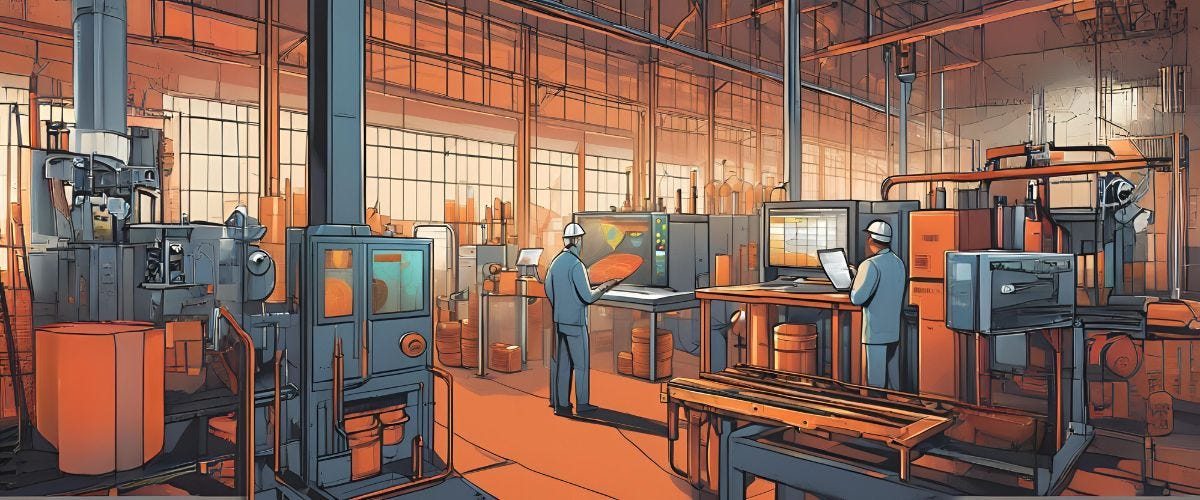
I went to Google (ok, I actually started with Perplexity and ChatGPT and then switched to Google for more detailed research) to figure out some of the KPIs that matter in manufacturing. I picked some that I believe can really help show inefficiencies and support process improvement over time and cross-checked them to what is already implemented.
I know a lot of you work in physical goods companies, so I thought sharing 4 of the most popular KPIs in the industry might be beneficial to some of you.
Overall Equipment Effectiveness (OEE)
It seems that this one is the holy grail for manufacturing. It tells us how well the company's equipment is being used by combining 3 factors: Availability, Performance, and Quality.
We can calculate OEE by multiplying those three (we'll see how to calculate them below).
OEE = Availability x Performance x Quality
Availability
The Availability measure shows how much of the time the equipment is available when it should be. For example, if we have 2 8-hour shifts, then the planned production time can be 15 hours (considering regulatory breaks for operators).
Then we can track the actual time equipment was running and calculate Availability as follows:
A = Operating Time / Planned Production Time (in %)
Essentially, Availability shows what % of the time we were able to use our equipment.
Performance
This one measures if the equipment is running at maximum potential speed. For example, if there's a process stage where someone has to physically change a setting or replace a detail that's being worked on, or provide raw materials - do they do that efficiently? Additionally, if the machine can work faster with better maintenance, are we doing it?
We calculate Performance as follows
P = (Ideal Cycle Time x Total Pieces) / Operating Time (in %)
Here we calculate the time producing all pieces would have taken if every step of the process was performed with maximum efficiency and see how close it is to the total time the equipment operated.
Quality
With this measure, we can check if the manufacturing process results in products that are ready to ship without requiring any re-working and fixing.
We calculate it using the formula;
Q = Good Pieces / Total Pieces (in %)
The Quality measure shows what percentage of our production was ready to ship after being produced, essentially outlining any issues with high/abnormal wastage.
Combining those three, we get OEE, which is a crucial metric for the manufacturing industry. It provides us with a comprehensive overview of where losses occur in the business. By tracking OEE over time and finding where issues stem for, we can prioritize our improvement efforts to areas with highest potential impact.
To boost OEE, we have to focus on the three metrics that make it up.
Availability can be improved by increasing our preventive maintenance measures. By setting up a regular diagnostics process for our equipment, we can prevent large outages by regular maintenance.
To increase Performance, we can focus our efforts into streamlining the machining process as much as possible by improving (and completely eliminating where possible) the manual steps and optimizing equipment settings.
And, last but not least, we must enhance our quality control processes to ensure no unfit items leave the production floor. That way we can not only improve our image and reputation with customers but will also increase the Quality measure in the process.
Focusing on these areas will help us improve our Overall Equipment Efficiency dramatically, which will have a direct impact on the company's bottom line.
Cycle Time
This is another important KPI in manufacturing. It's a metric that shows the average time it takes to process raw materials into a completed end-product. It generally calculates the total time to complete one production cycle from start to finish. However, in some situations, we can split the production process into particular operations and calculate the cycle time for those individually.
When analyzing and benchmarking, it's important to remember that generally, the metric considers all steps of the production cycle (incl. any handling, wait times, etc.).
We calculate it via the following simple formula:
Cycle Time = End Time - Start Time
However, in the context of averaging the cycle time, we can adopt a slightly different formula for better results:
Cycle Time = Operating Time / Total Pieces
Tracking and analyzing the company's Cycle Time is crucial for finding bottlenecks and inefficiencies. As a high Cycle Time can essentially slow down the entire production line, it is important to keep an eye on this metric and actively look for improvement opportunities.
Some ways to decrease Cycle Time include streamlining each step of the process, automating repetitive tasks, and improving the coordination and communication between different production stages.
Throughput
Throughput shows us the average number of produced items over a specific period that match the quality requirements within the business. It's a measure all about rate of production.
We can calculate Throughput using the following formula:
Throughput = Good Pieces / Operating Time
We prefer a higher Throughput as it shows an efficient process and good use of the available resources. If it increases over time, it means the company is perfecting its processes and is getting better.
We can increase this metric by working to reduce cycle times, minimizing equipment downtime, and refining resource allocation across our production process.
The end goal here is to speed up the entire production line as much as possible without compromising quality.
Yield
The Yield metric shows the percentage of products that meet quality standards on the first try, meaning they don't need any reworking or fixes. It's a very straightforward indicator of the effectiveness of the production process.
We can calculate it as follows:
Yield = Good Pieces / Total Pieces (in %)
If the metric is growing it means processes are well controlled and produce high quality items. You may also not this is exactly the same calculation as the Quality portion of the OEE we looked at above.
However, I wanted to keep this as a separate one, as I believe tracking it on its own can be quite beneficial. Additionally, it's a much more straightforward metric if you plan to assign KPIs to the people managing the manufacturing processes.
In order to improve Yield, we have to focus on strict quality control, training employees on best practices, and monitoring variability in the Yield with the entire organization's buy-in.

Understanding and improving these KPIs can significantly enhance your manufacturing process. It's like having a clear map towards finding inefficiencies, reducing waste, and boosting overall productivity.
My research of manufacturing KPIs led me much deeper, as I needed to understand those in the premise of the production processes at the company I started working at, but I strongly believe these 4 are a must for any company in the field.
Tracking OEE, Cycle Time, Throughput, and Yield won't solve your problems or improve the effectiveness on its own, but it's a great starting point, especially if (like me) you are new in the industry and want to better understand how the business works.
If you work in a manufacturing setting and you want to truly make a huge difference in the production process, try focusing on implementing strategies such as preventive maintenance. Additionally, regularly review processes for optimization opportunities, make sure employees are trained on best practices, and overall aim to foster a culture of continuous improvement.
That's a bulletproof recipe for success.
Thanks for making it to the end. Extra brownie points if you share the newsletter with your best friend (or your worst enemy). It's the only way I can grow and reach more people who might find what I have to say interesting.
Till next week.
Best,
Dobri 🍃